Turf is one of the final elements to go down on most construction and development projects, yet it’s often one of the least planned for. For project managers working across residential estates, commercial developments, council infrastructure and civil works in Southeast Queensland, understanding how long turf takes to fully establish can be the difference between a smooth handover and a costly delay.
At Allenview Turf, we work closely with project managers, developers and landscape contractors across Brisbane, Gold Coast, Ipswich and the wider region. One of the most common conversations we have is around timing, and the reality is that turf establishment is not a single event. It’s a process with distinct phases, each with its own requirements and risks. Getting the timeline right from the outset allows you to plan resources, manage client expectations and avoid the kind of setbacks that push practical completion dates.
Understanding What “Established” Actually Means
Before mapping out a timeline, it’s worth defining what turf establishment looks like in a project context. A lawn that looks green on the surface is not necessarily established. True establishment means the turf has developed a root system that has fully integrated with the underlying soil profile, the leaf canopy has filled in to provide complete coverage, and the surface is stable enough to handle its intended use, whether that’s foot traffic, vehicle access, or recreational activity.
For most warm-season varieties used in Southeast Queensland, full establishment takes anywhere from six to twelve weeks, depending on the time of year, the variety selected, site conditions and the level of post-installation care. That window needs to be factored into your project schedule well before the turf arrives on site.
Phase One: Site Preparation
Site preparation is where many projects either set themselves up for success or introduce problems that compound throughout the establishment period. The turf installation itself might take a day or two, but the groundwork leading up to it can take considerably longer, particularly on sites with compacted fill, poor drainage, or contaminated soil profiles.
At a minimum, the site needs to be cleared of debris, graded to appropriate levels with falls directed away from structures, and the top 100 to 150 millimetres of soil should be loosened and amended if necessary. On larger commercial and civil projects, this phase may also include the installation of irrigation infrastructure, subsurface drainage and retaining edges.
For project managers, the key consideration here is that site preparation cannot be rushed without consequences. Turf laid on poorly prepared ground will struggle to root, retain moisture unevenly, and ultimately require remediation that costs more than doing it properly the first time. It’s important to allow a realistic window for this phase based on site size and complexity, and ensure earthworks are completed and settled before scheduling turf delivery.
Phase Two: Installation
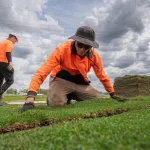
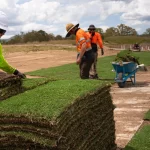
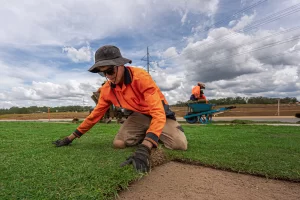
Turf installation on a well-prepared site is relatively fast. A competent laying crew can cover significant areas in a single day, and Allenview Turf can deliver up to 1,260 square metres on a single full truck. For larger projects, we coordinate staged deliveries to ensure turf is laid within hours of harvest, which is critical for plant health and successful establishment.
The installation phase typically runs one to three days for most commercial projects, though larger civil works or staged developments may extend across several weeks depending on how the project is sequenced. The important thing to understand is that turf is a perishable product. Once harvested, it needs to be on the ground and watered in as quickly as possible, particularly during the warmer months. Scheduling turf delivery for a Friday afternoon with no irrigation or weekend crew in place is a scenario we see too often, and it almost always leads to turf stress or failure.
For projects using maxi rolls rather than standard slabs, installation is faster and produces fewer joins, which can be a practical advantage on open areas like parks, playing fields and road verges. Our team can advise on the best format for your specific project requirements.
Phase Three: The Critical First Two Weeks
The first fourteen days after installation are the most critical period in the establishment timeline. During this window, the turf is surviving on stored energy and whatever moisture it can access from the soil surface. Roots have not yet penetrated deeply, which means the turf is highly vulnerable to heat stress, drying out, and displacement.
Irrigation during this phase needs to be frequent and consistent. In Southeast Queensland’s warmer months, that typically means watering two to three times per day for the first week, then gradually reducing to once daily in the second week. The goal is to keep the soil beneath the turf consistently moist without waterlogging the surface.
For project managers, this is where handover planning becomes critical. If the turf is being installed before practical completion, someone needs to be responsible for irrigation management during this window. That might be your landscape contractor, a site maintenance team, or the end client, but it needs to be clearly defined and documented. A two-week gap with no watering accountability is one of the fastest ways to lose an entire turf installation.
Phase Four: Root Establishment (Weeks Two to Six)
Once the turf has survived the initial settling-in period, the focus shifts to root development. During weeks two through six, the grass is actively sending roots down into the soil profile and beginning to anchor itself. You can track this progress with a simple tug test. Gently pull on a section of turf, and if it resists lifting, roots are taking hold. If it peels away easily, establishment is still in its early stages.
Irrigation can be gradually reduced during this phase, transitioning from daily watering to deeper, less frequent sessions that encourage roots to grow downward rather than staying at the surface. Mowing can typically commence once the turf has rooted sufficiently that it won’t shift under the mower, which is usually around the three to four week mark, depending on growth rates.
This is also the phase where variety selection starts to show its impact. A faster-establishing variety like Stadium Couch or Wintergreen Couch will root and fill in more quickly than a slower-growing variety like Empire Zoysia, which trades speed for long-term density and lower maintenance requirements. Palmetto Buffalo sits in the middle, offering reliable establishment with excellent shade tolerance for sites where tree cover or building shadows are a factor.
Phase Five: Full Establishment (Weeks Six to Twelve)
Full establishment is the point at which the turf has developed a mature root system, the canopy has closed over any visible joins, and the surface is ready for its intended use. For most warm-season varieties in Southeast Queensland conditions, this occurs somewhere between six and twelve weeks after installation.
Several factors influence where a project falls within that range. Turf installed during the active growing season from October through to March will establish faster than turf laid during the cooler months from April through August, when growth rates slow significantly. Soil quality, irrigation consistency, and whether the site receives full sun or partial shade all play a role as well.
For project managers working to fixed completion dates, the practical takeaway is straightforward. If you need turf fully established by a certain date, count backward from that date by at least eight to ten weeks to determine when installation needs to occur, then add your site preparation time on top of that. Building this into your program early avoids the pressure of trying to compress a biological process that simply cannot be rushed.
How Seasonal Timing Affects Your Program
Southeast Queensland’s subtropical climate is generally favourable for turf establishment year-round, but the speed and ease of establishment varies considerably by season.
Spring and early summer provide the fastest establishment conditions. Warm soil temperatures, increasing daylight hours and active plant growth mean turf roots aggressively and fills in quickly. This is the ideal window for projects where a tight establishment timeline is critical.
Autumn offers reliable establishment with the added benefit of reduced irrigation demand as temperatures ease and rainfall becomes more consistent. For many commercial projects, autumn installation strikes a practical balance between establishment speed and resource efficiency.
Winter installations are absolutely viable in Southeast Queensland, but project managers should plan for a longer establishment window. Growth rates slow during the cooler months, and turf may take eight to twelve weeks to reach full establishment compared to six to eight weeks during the warmer season. This does not mean winter is a poor time to install. It simply means the timeline needs to reflect the conditions.
Variety Selection and Its Impact on Timelines
The turf variety you specify has a direct impact on how quickly the project reaches full establishment. Each variety has different growth habits, and understanding these can help you make informed decisions during the planning phase.
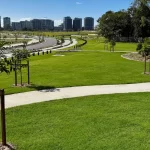
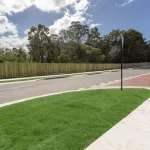
Stadium Couch and Wintergreen Couch are among the fastest establishing varieties available. Their aggressive lateral growth means they fill in joins quickly and develop a dense, wear-tolerant surface in a relatively short timeframe. These are strong choices for projects where establishment speed is a priority, such as sporting fields, road verges and public open spaces that need to be trafficable as soon as possible.
Palmetto Buffalo is a reliable mid-range performer that establishes well across a variety of site conditions. Its shade tolerance makes it a practical specification for developments where buildings, fences or existing vegetation create shadowed areas that other varieties would struggle in.
Empire Zoysia is a slower establisher, but what it lacks in early speed it makes up for in long-term performance. Once established, Empire requires significantly less mowing and watering than other varieties, making it a cost-effective specification for developments where ongoing maintenance budgets are a consideration. It is well-suited to premium residential estates, resort-style developments and commercial landscapes where a fine-textured, manicured appearance is valued.
Common Mistakes That Delay Establishment
In our experience working with project managers across Southeast Queensland, the same establishment issues tend to come up repeatedly. Poor soil preparation is the most common. Turf laid on compacted fill or clay subsoil without adequate amendment will struggle to root regardless of how well it’s maintained after installation.
Inadequate irrigation planning is the second most frequent issue. On large projects, ensuring even water coverage across the entire installation area is not always straightforward, and dry spots that are missed during the critical first weeks often result in turf failure that requires replacement.
The third common issue is premature use. Opening a turfed area to foot traffic, vehicle access or heavy use before the root system has fully anchored will cause displacement, compaction and uneven surfaces that are difficult and expensive to rectify. Communicating realistic establishment timelines to end clients and stakeholders from the outset helps manage expectations and protects the investment in the turf installation.
Planning for Success
Turf establishment is a biological process, and while it can be supported and optimised, it cannot be artificially accelerated. The most successful projects we work on are the ones where the project manager has factored turf into the program early, allowed realistic timeframes for each phase, and ensured that post-installation care responsibilities are clearly assigned.
At Allenview Turf, we work with project managers throughout the planning and delivery process. From variety selection and site assessment through to coordinating staged deliveries and advising on post-installation care programs, our team is here to help your project run smoothly and your turf establish on schedule. If you have a project in the pipeline and want to discuss timing, quantities or variety recommendations, get in touch with our team on 07 5543 2921 or reach out via sales@allenviewturf.com.au.